Both Ethics and Ethical Concepts are Man-Made
Both Ethics and Ethical Concepts are Man-Made
We may think of ethics as man-made. If so, we should also appreciate that the concepts we use to think about ethics are fallible human creations that can be improved.
Ethics Is Man-Made
I will start with ethics itself, in which I include all judgements about what to do and all rules of conduct across practical reason broadly and morality more narrowly. I think all of this is man-made. For a naturalist, who assumes there is nothing supernatural, there seems to be no alternative. I don’t think that ethical judgements and rules have a special non-natural metaphysic – they don’t exist in an independent realm of natural law, they aren’t mysteriously discovered by conscience, they aren’t divine commands. As instinctive and tempting as such ideas may be, they all involve magical thinking. Instead, I think our judgements about what to do, and our moral rules, are stuff that we, acting within the natural world, make up. But this doesn’t mean that they are arbitrary and aren’t important. There are better and worse practical judgements and rules, and our survival and flourishing depend on making good choices, including using reason to improve welfare. Although practical reason and morality may be made-made, they are real as they are grounded in facts in the world, can be reasoned about and they matter.
Ethical Concepts Are Also Man-Made
Similarly, we should recognise that the concepts we use to think about practical reason and morality are man-made. Our inherited ethical language and ways of thinking come from cultural evolution not from God. We should appreciate that we are not obliged to stick with our conceptual inheritance, but can critically examine existing concepts, and revise them when useful. Metaethics, the study of ethical concepts, should involve both the (notably hard) descriptive task of understanding our ethical language and thinking, and the normative task of suggesting how it can be improved.
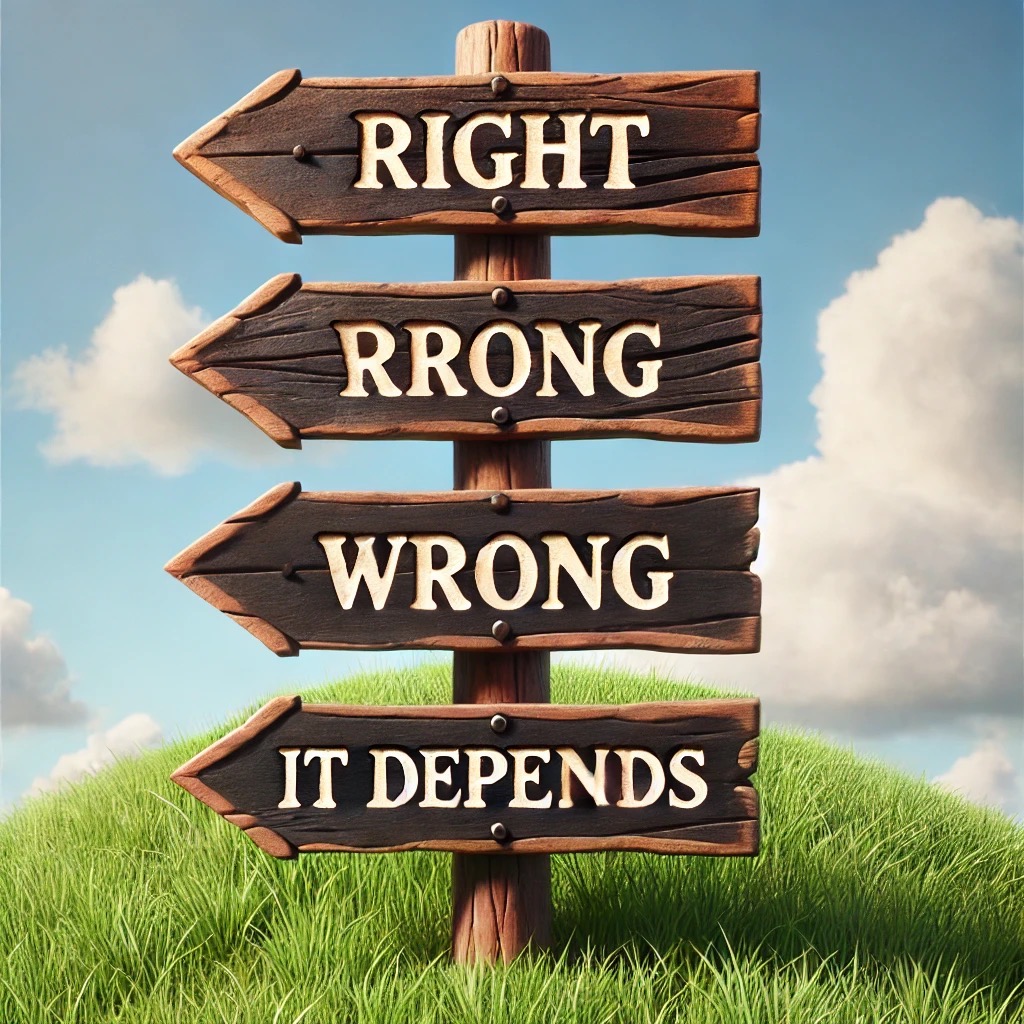
An example of a way of thinking that can be improved is the binary character of much ethical language. We commonly talk about binary right v. wrong and good v. bad, but we could instead make scaler judgements where actions are better by degrees. This would reflect reality being grey rather than black and white. We can advance our conceptual schemes past traditional binary thinking to think more subtlety.
Another example, dear to my heart, is that ‘morality’ is traditionally thought of as the central ethical concept. Instead, my suggestion is to take ‘practical reason’, deciding what to do more broadly, as primary, with ‘morality’ subsidiary to that. I find this re-ordering of ethical concepts helpful as it reflects the breadth of human decision-making and avoids the varieties of meanings and supernatural connotations of the term ‘morality.’
An Inappropriate Moral Concept
A striking case of inappropriate use of an inherited ethical concept comes with the ‘demandingness’ criticism of consequentalism. The central consequentalist idea is that some states of the world are better than others and actions should be directed towards obtaining the better states. The mistake has been to combine this consequentalist idea with a conception of morality under which the individual only acts morally if he does the most possible good. Under this idea of morality, the demands of consequentalism become excessive, and anything less than complete sacrifice to the needs of others is judged morally wrong. This has been taken to show that consequentalism is unworkable, but Alistair Norcross instead sees the problem as not with the central idea of consequentalism, but with trying to graft it on to an absolutist ethical concept.
A Pluralistic Conceptual Scheme
We can do better. As Richard Chappell proposes, we can instead have a pluralistic conceptual scheme which recognises different types of consequentalist judgements. Chappell thinks the core consequentalist assessment should be a scalar one – in general the more good that is produced, the more reason we have to produce it. But this can be supplemented by two other concepts. First, we can have a maximizing, aspirational concept of what produces the most good. And second, we can have a satisficing concept of a minimum needed to avoid moral blame. So, when it comes to helping others: generally, the more the better, although ideally you would give everything away, and at a minimum you must at least save drowning children.
The Potential of Metaethics
I am impressed how Chappell’s pluralistic conceptual scheme goes past the distortions created by a traditional binary moral concept, to provide the resources to think more clearly and freely about the normative domain. To me it demonstrates the potential of metaethics – to replace limiting and confusing inherited ethical concepts with better conceptual schemes. The possibility of revising our ethical concepts should be an important dimension to ethical thinking.
Notes
Chappell, Richard Yetter. 2020. “Deontic Pluralism and the Right Amount of Good.” In The Oxford Handbook of Consequentalism, by Douglas W Portmore. Available on Philpapers.
Norcross, Alistair. 2020. Morality By Degrees: Reasons Without Demands. My notes on the book.