Bertrand Russell: What I Believe
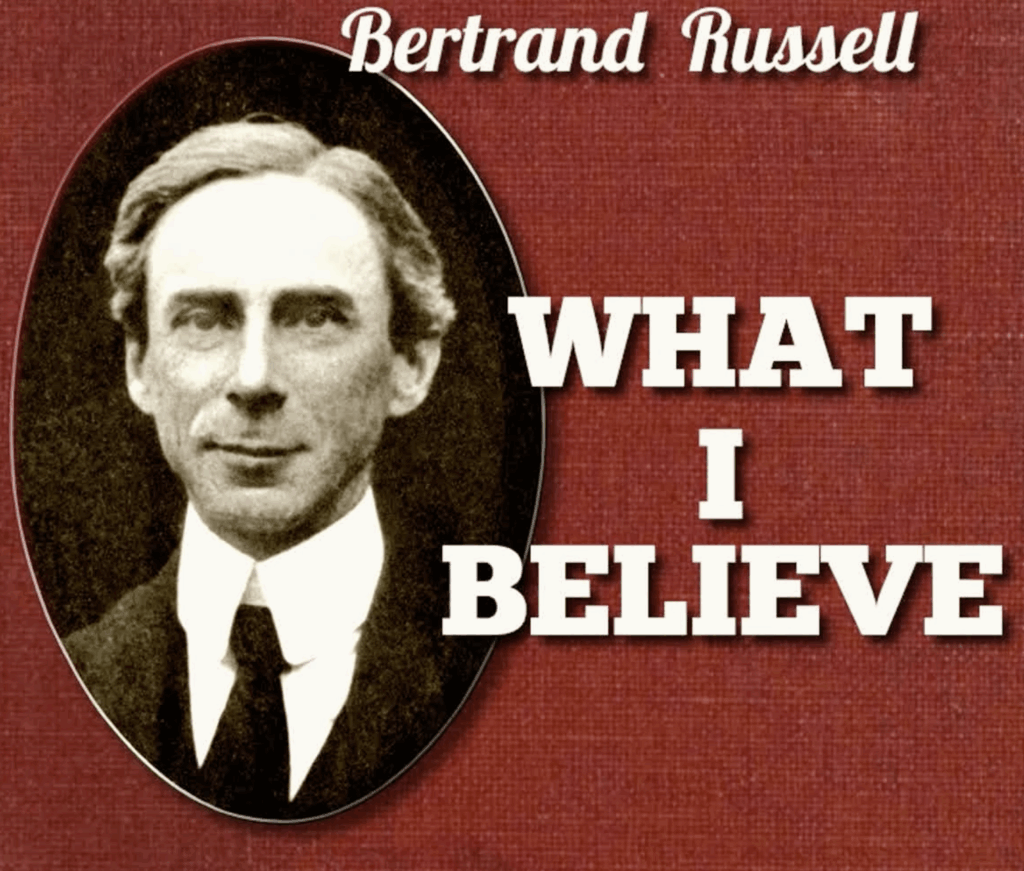
Bertrand Russell. What I Believe (1925)
In a paragraph
The good life is one inspired by love and guided by knowledge. Man is part of nature, not something contrasted with nature. Outside human desires there is no moral standard.
Key points
- ‘Man is part of Nature not something contrasted with Nature.’ ‘It is only facts on or near the surface of the earth that we can, to some extent, mould to suit our desires.’ ‘The great world, so far as we know it from the philosophy of nature, is neither good nor bad, and is not concerned to make us happy or unhappy. All such philosophies spring from self-importance, and are best corrected by a little astronomy.’
- ‘Religion, since it has its source in terror, has dignified certain kinds of fear, and made people think them not disgraceful. In this it has done mankind a great disservice: all fear is bad. I believe that when I die I shall rot, and nothing of my ego will survive. I am not young, and I love life. But I should scorn to shiver with terror at the thought of annihilation. Happiness is none the less true happiness because it must come to an end, nor do thought and love lose their value because they are not everlasting. Many a man has borne himself proudly on the scaffold; surely the same pride should teach us to think truly about man’s place in the world. Even if the open windows of science at first make us shiver after the cosy indoor warmth of traditional humanising myths, in the end the fresh air brings vigour, and the great spaces have a splendour of their own.’
- ‘The good life is one inspired by love and guided by knowledge.’ ‘An able physician is more useful to a patient than the most devoted friend’. Love combines ‘delight in contemplation’ and ‘benevolence.’
- We can use reason to achieve our goals but cannot reason about our choice of goals. On a view of the good life ‘no argument is possible. I cannot, therefore, prove that my view of the good life is right; I can only state my view, and hope that as many as possible will agree.’ Our goals are to satisfy our desires. ‘All moral rules must be tested by examining whether they tend to realise ends that we desire.’ ‘Outside human desires there is no moral standard.’
- Moral rules are needed to deal with conflicting desires between people and within a life. ‘Current morality is a curious blend of utilitarianism and superstition, but the superstitious part has the stronger hold.’ Superstitions create suffering, such as in religious opposition to contraception.
- ‘The good life must be lived in a good society, and is not fully possible otherwise.’ Aristocracy is unsatisfactory as it requires treating others as of lower worth.
- Harmful actions arise either from ignorance or from anti-social desires. Many anti-social desires come from fear, and fear can be reduced either by improving security or by promoting courage. ‘So far, it has been physical science that has had most effect upon our lives, but in the future physiology and psychology are likely to be far more potent. When we have discovered how character depends upon physiological conditions, we shall be able, if we choose, to produce far more of the type of human being that we admire.’
Comments
‘What I Believe’ is a short book (or an extended essay) in which Russell sets out his worldview. He covers the place of man in the universe, his view of the good life and the possibility of improvements from reducing fears and making morality more rational.
The great line from the book is ‘The good life is one inspired by love and guided by knowledge.’ The book’s central theme relates to this – to use reason to face up to and make the most of the world.
But under Russell’s view of the nature of morality (his metaethics), using reason does not extend to choosing goals. For him, ends come from desires, which cannot be argued about. It therefore may seem odd that Russell tries to persuade throughout the book. But Russell thought that although he couldn’t use arguments about questions of values, he could still preach, and that is what he would do, to try to get others to share his desires.
In his views, Russell was aligned with the metaethical consensus of his time. Morality was thought not to be a matter of reason, so philosophers had no particular contribution to make to substantive debates. This now seems wrong, as I have argued. See Charles Pigden for a commentary on Russell’s ethics. And see Peter Singer’s Tanner lecture for a discussion of how practical ethics advanced after Russell. I am strongly in favour of Russell’s practical ethics, but strongly against his metaethics.
Russell’s writing voice is distinctive and delightful. Paragraphs are constructed with exceptional phrasing and clarity. Apparently, he dictated what he wrote and made few revisions. This may have allowed the book’s global structure to remain less disciplined, despite the quality of the phrases and paragraphs.
Links
Book available for free download from Project Gutenburg
My blog post Yes, We Can Reason About Ends
Charles Pigden Stanford Encyclopaedia of Philosophy article on Russell’s Moral Philosophy.
Peter Singer Tanner Lecture From Moral Neutrality to Effective Altruism
My notes on Russell’s Autobiography
Extracts
Introduction
In this little book, I have tried to say what I think of man’s place in the universe, and of his possibilities in the way of achieving the good life. In Icarus I expressed my fears; in the following pages I have expressed my hopes. The inconsistency is only apparent. Except in astronomy, mankind have not achieved the art of predicting the future; in human affairs, we can see that there are forces making for happiness, and forces making for misery. We do not know which will prevail, but to act wisely we must be aware of both.
1. Man and Nature
Man is a part of Nature, not something contrasted with Nature.
Physical science is approaching the stage when it will be complete, and therefore uninteresting.
God and immortality, the central dogmas of the Christian religion, find no support in science.
No doubt people will continue to entertain these beliefs, because they are pleasant, just as it is pleasant to think ourselves virtuous and our enemies wicked.
We know that the brain is not immortal, and that the organised energy of a living body becomes, as it were, demobilised at death, and therefore not available for collective action. All the evidence goes to show that what we regard as our mental life is bound up with brain structure and organised bodily energy. Therefore it is rational to suppose that mental life ceases when bodily life ceases.
Whoever considers conception, gestation, and infancy cannot seriously believe that the soul is any indivisible something, perfect and complete throughout this process. It is evident that it grows like the body. This is not materialism: it is merely the recognition that everything interesting is a matter of organisation, not of primal substance.
If we were not afraid of death, I do not believe that the idea of immortality would ever have arisen.
Fear is the basis of religious dogma, as of so much else in human life.
Distinguish things that can be affected by our desires and things that cannot be so affected. The line between the two is neither sharp nor immutable—as science advances, more and more things are brought under human control. Nevertheless there remain things definitely on the other side. Among these are all the large facts of our world, the sort of facts that are dealt with by astronomy. It is only facts on or near the surface of the earth that we can, to some extent, mould to suit our desires. And even on the surface of the earth our powers are very limited. Above all, we cannot prevent death, although we can often delay it.
Religion is an attempt to overcome this antithesis. If the world is controlled by God, and God can be moved by prayer, we acquire a share in omnipotence. In former days, miracles happened in answer to prayer; they still do in the Catholic Church, but Protestants have lost this power.
Religion, since it has its source in terror, has dignified certain kinds of fear, and made people think them not disgraceful. In this it has done mankind a great disservice: all fear is bad. I believe that when I die I shall rot, and nothing of my ego will survive. I am not young, and I love life. But I should scorn to shiver with terror at the thought of annihilation. Happiness is none the less true happiness because it must come to an end, nor do thought and love lose their value because they are not everlasting. Many a man has borne himself proudly on the scaffold; surely the same pride should teach us to think truly about man’s place in the world. Even if the open windows of science at first make us shiver after the cosy indoor warmth of traditional humanising myths, in the end the fresh air brings vigour, and the great spaces have a splendour of their own.
The philosophy of nature is one thing, the philosophy of value is quite another. Nothing but harm can come of confusing them.
Undoubtedly we are part of nature, which has produced our desires, our hopes and fears, in accordance with laws which the physicist is beginning to discover. In this sense we are part of nature, we are subordinated to nature, the outcome of natural laws, and their victims in the long run.
The philosophy of nature must not be unduly terrestrial; for it, the earth is merely one of the smaller planets of one of the smaller stars of the Milky Way. It would be ridiculous to warp the philosophy of nature in order to bring out results that are pleasing to the tiny parasites of this insignificant planet. Vitalism as a philosophy, and evolutionism, show, in this respect, a lack of sense of proportion and logical relevance. They regard the facts of life, which are personally interesting to us, as having a cosmic significance, not a significance confined to the earth’s surface. Optimism and pessimism, as cosmic philosophies, show the same naive humanism; the great world, so far as we know it from the philosophy of nature, is neither good nor bad, and is not concerned to make us happy or unhappy. All such philosophies spring from self-importance, and are best corrected by a little astronomy.
But in the philosophy of value the situation is reversed. Nature is only a part of what we can imagine; everything, real or imagined, can be appraised by us, and there is no outside standard to show that our valuation is wrong. We are ourselves the ultimate and irrefutable arbiters of value, and in the world of value Nature is only a part. Thus in this world we are greater than Nature. In the world of values, Nature in itself is neutral, neither good nor bad, deserving of neither admiration nor censure. It is we who create value and our desires which confer value. In this realm we are kings, and we debase our kingship if we bow down to Nature. It is for us to determine the good life, not for Nature—not even for Nature personified as God.
2. The Good Life
There have been at different times and among different people many varying conceptions of the good life. To some extent the differences were amenable to argument; this was when men differed as to the means to achieve a given end. Some think that prison is a good way of preventing crime; others hold that education would be better. A difference of this sort can be decided by sufficient evidence. But some differences cannot be tested in this way. Tolstoy condemned all war; others have held the life of a soldier doing battle for the right to be very noble. Here there was probably involved a real difference as to ends. Those who praise the soldier usually consider the punishment of sinners a good thing in itself; Tolstoy did not think so. On such a matter no argument is possible. I cannot, therefore, prove that my view of the good life is right; I can only state my view, and hope that as many as possible will agree. My view is this: The good life is one inspired by love and guided by knowledge. Knowledge and love are both indefinitely extensible; therefore, however good a life may be, a better life can be imagined. Neither love without knowledge, nor knowledge without love can produce a good life.
Although both love and knowledge are necessary, love is in a sense more fundamental, since it will lead intelligent people to seek knowledge, in order to find out how to benefit those whom they love. But if people are not intelligent, they will be content to believe what they have been told, and may do harm in spite of the most genuine benevolence. Medicine affords, perhaps, the best example of what I mean. An able physician is more useful to a patient than the most devoted friend, and progress in medical knowledge does more for the health of the community than ill-informed philanthropy.
Love is a word which covers a variety of feelings; I have used it purposely, as I wish to include them all. Love as an emotion—which is what I am speaking about, for love ‘on principle’ does not seem to me genuine—moves between two poles: on one side, pure delight in contemplation; on the other, pure benevolence. Delight without well-wishing may be cruel; well-wishing without delight easily tends to become cold and a little superior.
I think that in all descriptions of the good life here on earth we must assume a certain basis of animal vitality and animal instinct; without this, life becomes tame and uninteresting. Civilisation should be something added to this, not substituted for it; the ascetic saint and the detached sage fail in this respect to be complete human beings. A small number of them may enrich a community; but a world composed of them would die of boredom.
When I speak of knowledge as an ingredient of the good life, I am not thinking of ethical knowledge, but of scientific knowledge and knowledge of particular facts. I do not think there is, strictly speaking, such a thing as ethical knowledge. All moral rules must be tested by examining whether they tend to realise ends that we desire. I say ends that we desire, not ends that we ought to desire. What we ‘ought’ to desire is merely what someone else wishes us to desire. Usually it is what the authorities wish us to desire. Since all behaviour springs from desire, it is clear that ethical notions can have no importance except as they influence desire.
The question for the legislative moralist is, therefore: How shall this system of rewards and punishments be arranged so as to secure the maximum of what is desired by the legislative authority? If I say that the legislative authority has bad desires, I mean merely that its desires conflict with those of some section of the community to which I belong. Outside human desires there is no moral standard. Thus, what distinguishes ethics from science is not any special kind of knowledge but merely desire. The knowledge required in ethics is exactly like the knowledge elsewhere; what is peculiar is that certain ends are desired, and that right conduct is what conduces to them.
When I said that the good life consists of love guided by knowledge, the desire which prompted me was the desire to live such a life as far as possible, and to see others living it; and the logical content of the statement is that, in a community where men live in this way, more desires will be satisfied than in one where there is less love or less knowledge. I do not mean that such a life is ‘virtuous’ or that its opposite is ‘sinful’, for these are conceptions which seem to me to have no scientific justification.
3. Moral Rules
The practical need of morals arises from the conflict of desires, whether of different people or of the same person at different times or even at one time. A man desires to drink, and also to be fit for his work next morning. We think him immoral if he adopts the course which gives him the smaller total satisfaction of desire.
Current morality is a curious blend of utilitarianism and superstition, but the superstitious part has the stronger hold, as is natural, since superstition is the origin of moral rules. Originally, certain acts were thought displeasing to the gods, and were forbidden by law because the divine wrath was apt to descend upon the community, not merely upon the guilty individuals. Hence arose the conception of sin, as that which is displeasing to God.
Let us follow an ordinary human life from conception to the grave, and note the points where superstitious morals inflict preventable suffering. I begin with conception, because here the influence of superstition is particularly noteworthy. If the parents are not married, the child has a stigma, as clearly undeserved as anything could be. If either of the parents has venereal disease, the child is likely to inherit it. If they already have too many children for the family income, there will be poverty, underfeeding, overcrowding, very likely incest. Yet the great majority of moralists agree that the parents had better not know how to prevent this misery by preventing conception. To please these moralists, a life of torture is inflicted upon millions of human beings who ought never to have existed.
In all stages of education the influence of superstition is disastrous. A certain percentage of children have the habit of thinking; one of the aims of education is to cure them of this habit.
4. Salvation: Individual and Social
In all that differentiates between a good life and a bad one, the world is a unity, and the man who pretends to live independently is a conscious or unconscious parasite.
In the orthodox Christian conception, the good life is the virtuous life, and virtue consists in obedience to the will of God, and the will of God is revealed to each individual through the voice of conscience. This whole conception is that of men subject to an alien despotism. The good life involves much beside virtue—intelligence, for instance. And conscience is a most fallacious guide, since it consists of vague reminiscences of precepts heard in early youth, so that it is never wiser than its possessor’s nurse or mother. To live a good life in the fullest sense a man must have a good education, friends, love, children (if he desires them), a sufficient income to keep him from want and grave anxiety, good health, and work which is not uninteresting. All these things, in varying degrees, depend upon the community, and are helped or hindered by political events. The good life must be lived in a good society, and is not fully possible otherwise.
This is the fundamental defect of the aristocratic ideal. Certain good things, such as art and science and friendship, can flourish very well in an aristocratic society. They existed in Greece on a basis of slavery; they exist among ourselves on a basis of exploitation. But love, in the form of sympathy, or benevolence, cannot exist freely in an aristocratic society. The aristocrat has to persuade himself that the slave or proletarian or coloured man is of inferior clay, and that his sufferings do not matter.
There is no short cut to the good life, whether individual or social. To build up the good life, we must build up intelligence, self-control and sympathy. This is a quantitative matter, a matter of gradual improvement.
5. Science and Happiness
The purpose of the moralist is to improve men’s behaviour. This is a laudable ambition, since their behaviour is for the most part deplorable. But I cannot praise the moralist either for the particular improvements he desires or for the methods he adopts for achieving them. His ostensible method is moral exhortation; his real method (if he is orthodox) is a system of economic rewards and punishments.
Men’s actions are harmful either from ignorance or from bad desires. ‘Bad’ desires, when we are speaking from a social point of view, may be defined as those which tend to thwart the desires of others, or more exactly, those which thwart more desires than they assist.
It must, therefore, be one of the chief concerns of the scientific moralist to combat fear. This can be done in two ways: by increasing security, and by cultivating courage.
So far, it has been physical science that has had most effect upon our lives, but in the future physiology and psychology are likely to be far more potent. When we have discovered how character depends upon physiological conditions, we shall be able, if we choose, to produce far more of the type of human being that we admire. Intelligence, artistic capacity, benevolence—all these things no doubt could be increased by science.
To begin with, what is ‘natural’? Roughly speaking, anything to which the speaker was accustomed in childhood. Lao-Tze objects to roads and carriages and boats, all of which were probably unknown in the village where he was born. Rousseau has got used to these things, and does not regard them as against nature. But he would no doubt have thundered against railways if he had lived to see them. Clothes are contrary to nature, and need to be supplemented by another unnatural practice, namely washing, if they are not to bring disease. But the two practices together make a man healthier than the savage who eschews both.
But the amount and kind of work that most people have to do at present is a grave evil: especially bad is the life-long bondage to routine. Life should not be too closely regulated or too methodical; our impulses, when not positively destructive or injurious to others, ought if possible to have free play; there should be room for adventure. Human nature we should respect, because our impulses and desires are the stuff out of which our happiness is to be made.
To respect physical nature is foolish; physical nature should be studied with a view to making it serve human ends as far as possible, but it remains ethically neither good nor bad. And where physical nature and human nature interact, as in the population question, there is no need to fold our hands in passive adoration and accept war, pestilence and famine as the only possible means of dealing with excessive fertility. The divines say: it is wicked, in this matter, to apply science to the physical side of the problem; we must (they say) apply morals to the human side and practise abstinence. Apart from the fact that everyone, including the divines, knows that their advice will not be taken, why should it be wicked to solve the population question by adopting physical means for preventing conception? No answer is forthcoming except one based upon antiquated dogmas. And clearly the violence to nature advocated by the divines is at least as great as that involved in birth control. The divines prefer a violence to human nature, which, when successfully practised, involves unhappiness, envy, a tendency to persecution, often madness. I prefer a ‘violence’ to physical nature which is of the same sort as that involved in the steam engine or even in the use of an umbrella. This instance shows how ambiguous and uncertain is the application of the principle that we should follow ‘nature’.
Nature, even human nature, will cease more and more to be an absolute datum; more and more it will become what scientific manipulation has made it. Science can, if it chooses, enable our grandchildren to live the good life, by giving them knowledge, self-control, and characters productive of harmony rather than strife. At present it is teaching our children to kill each other, because many men of science are willing to sacrifice the future of mankind to their own momentary prosperity. But this phase will pass when men have acquired the same domination over their own passions that they already have over the physical forces of the external world. Then at last we shall have won our freedom.