Four Concepts of Reason
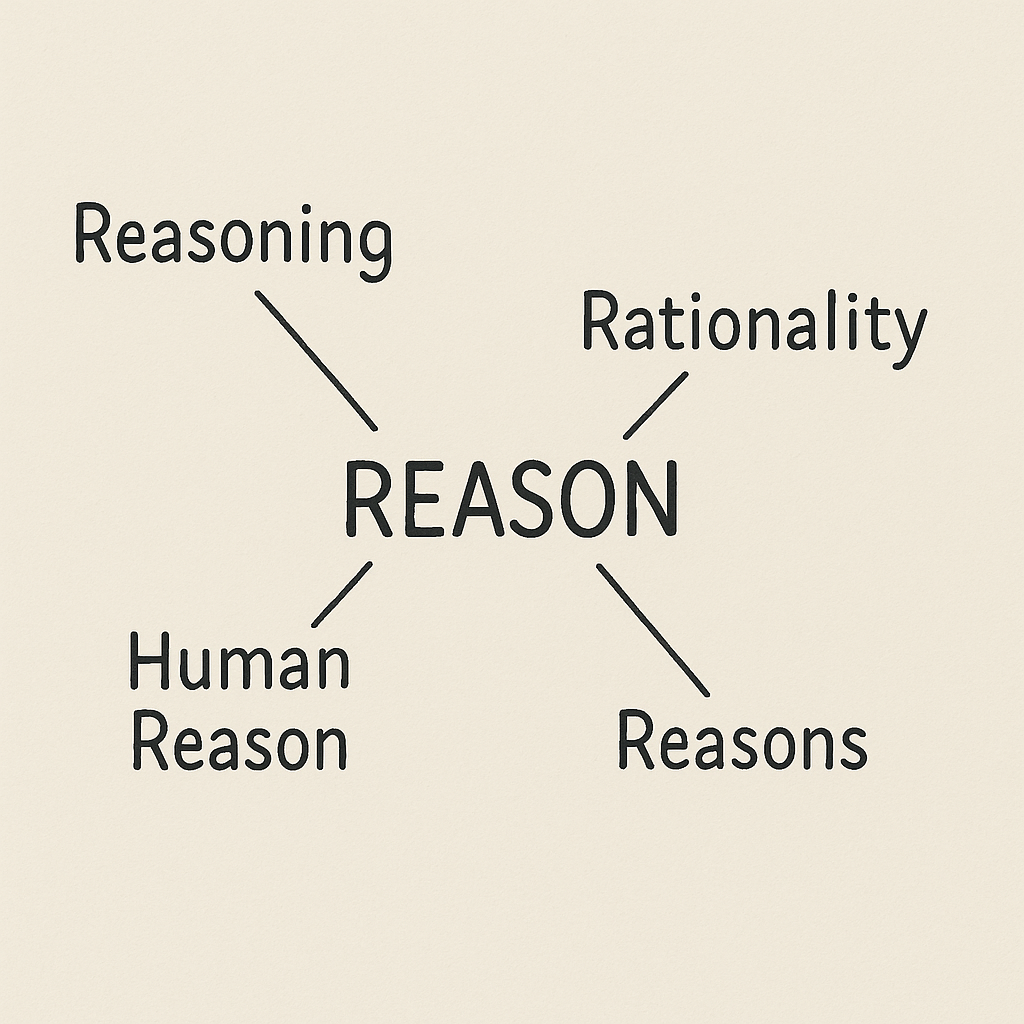
Four Concepts of Reason
‘Reason’ is a central word in philosophy, but, confusingly, has multiple meanings. It is helpful to distinguish four underlying concepts. These are (1) Reasoning, as an activity, (2) Rationality, as an ideal, (3) Human Reason, as a faculty and (4) Reasons, as explanations. Each of the four are important and worth understanding.
(1) Reason as an Activity: Reasoning
In this basic sense, ‘reason’ is the act of reasoning – of consciously thinking, including weighing evidence, using mathematics and logic, planning, drawing conclusions and checking coherence.
In psychology, reasoning is one side of the Dual Process Theory popularised by Daniel Kahneman, which distinguishes between two modes of thinking: System 1, which is fast, automatic, and intuitive, and System 2, which is slow, conscious, and effortful. The two modes are illustrated by the contrast between talking and writing. When we speak, we use System 1 to talk spontaneously and fluently, but when we write we use System 2 reasoning to pause, reflect, edit, and structure our thoughts with conscious effort. Both systems are essential: System 1 enables quick judgments, while System 2 allows planning and checking. But because System 2 reasoning is effortful, we often underuse it and don’t think things through.
However, in this first, purely descriptive sense, reasoning is not necessarily good. Our thinking may be poor, or we may be using it inappropriately when instincts or following others would serve us better.
(2) Reason as an Ideal: Rationality
But there is a second sense of ‘reason’ where ‘reason’ is always best. This is the normative ideal sense of reason as ‘rationality’ – as using the best methods to find answers. To use reason in this sense is not just for an individual to do some reasoning, but to think well, and as appropriate to access information, consult reliable sources, use reasoning tools and generally apply best knowledge-finding practice.
There are two broad areas where rationality is to be applied – to help form true beliefs and to help make good decisions about how to act – in philosophical lingo theoretical vs. practical reason or epistemic vs. instrumental rationality.
The ideal of rationality is promoted by the rationalist movement. On the LessWrong website, Eliezer Yudkowsky has argued that rationality should be treated as a discipline: the ongoing improvement of belief and action using tools of rationality. These tools include scientific method, logic, mathematics, probability, Bayesian reasoning and in particular awareness of biases. Steven Pinker also argues for rationality, arguing that its spread underlies human progress in science, morality, and governance.
(3) Reason as a Faculty: Human Reason
The third meaning of ‘reason’ is as a faculty—a general human capacity to think, judge, and deliberate. This ‘Human Reason’ conception is foundational in Western philosophy. For Plato, reason is the soul’s highest part; for Aristotle, humans are rational animals, defined by their ability to reason practically and theoretically; and for Kant, human reason is the source of both a priori knowledge and moral law.
Philosophers have historically debated this faculty’s role in knowledge. Rationalists such as Descartes, Spinoza, and Leibniz argued that human reason can discover truths independent of experience. Empiricists, notably Locke and Hume, argued that all knowledge originates in sensory experience, with reason limited to organising what is given by the senses.
Today, cognitive science studies the nature of human reason. It is seen as an information processing system with distinctive characteristics that arise from its evolved nature.
(4) Reason as Explanations: Reasons
Finally, the word ‘reason’ is used for explanations.
These include:
- Causal reasons: what made something happen.
‘The reason the fire started was faulty wiring.’ - Normative (justificatory) reasons: considerations that count in favour of something.
‘The reason you should exercise is to lose weight’ - Motivating reasons: the agent’s own rationale
‘She left because she felt ignored.’
Normative reasons are central to ethics. According to Derek Parfit, normative reasons are the fundamental constituents of ethics and need to be carefully distinguished from motivating reasons.
My Interest
Of the four senses, I have a particular interest in the second, Rationality. It is the concept of Rationality that underlies the thought that I want to use Reason to both understand the world and to guide my life. It also underlies a view of history as a battle between Reason and other sides of human nature. My aim is to be a Man of Reason, and I hope Reason wins out in human affairs. And by Reason here I mean Rationality – using the best available methods to find truth and to act well.
References
- Kahneman, D. (2011). Thinking, Fast and Slow.
- Yudkowsky, E. (2015). Rationality: From AI to Zombies.
- Pinker, S. (2018). Enlightenment Now.
- Pinker, S. (2021). Rationality: What It Is, Why It Seems Scarce, Why It Matters.
- Kant, I. (1785). Groundwork of the Metaphysics of Morals.
- Parfit, D. (2011). On What Matters.