Dean Spears and Michael Geruso. After the Spike.
Dean Spears and Michael Geruso
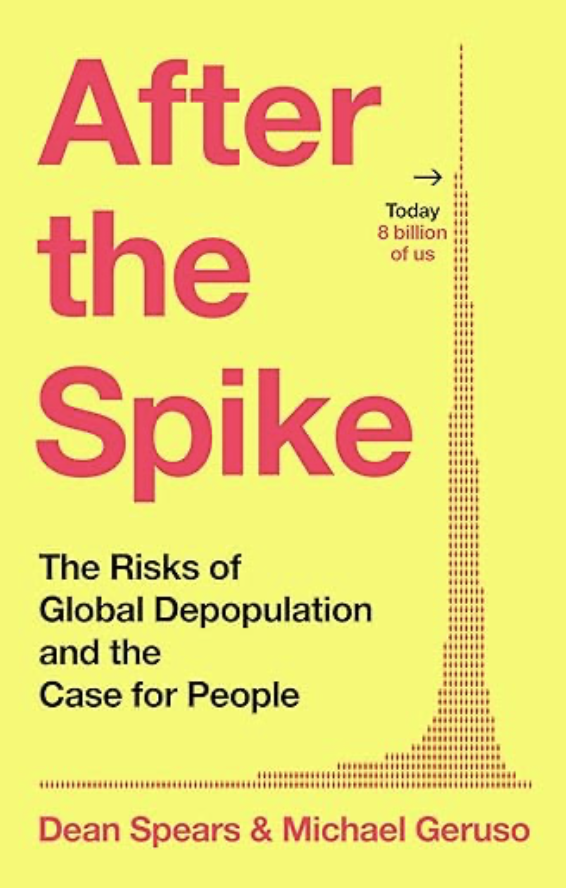
After The Spike: The Risks of Global Depopulation and the Case for People (2025)
In a paragraph
Global population is reaching the peak of a spike and will fall exponentially if fertility is below replacement levels. We should aim to halt depopulation as greater numbers benefit the extra people who live (‘More good is better’), and also causes prosperity through ideas generation and spreading fixed costs.
Key points
- Humanity is on a path to exponential depopulation. Stabilisation does not look likely unless societies choose it and work for it.
- The global fertility rate is projected to fall below the replacement fertility rate of 2.1 by 2050 and global population will peak around 2080. If the fertility rate is 1.6, population will decline below 2 billion in 300 years. 120 billion births have happened, and this will be fourth fifths of the lives ever lived.
- Demographic transition theory – from high mortality and high fertility, to low mortality and high fertility, and then to low mortality and low fertility. Population grows during transition. Trends seen back to Sweden in 1750.
- On climate, population changes have negligible effects during the immediate decades that will matter.
- On historic trends, we should expect lives to continue to get better. Then, if lives are worth living now, they will be worth living in the future.
- A more populous world should be more prosperous because of idea creation and fixed costs. Your neighbours are not eating your pie slice: they’re the reason someone is baking. Resources to remove greenhouse gasses or deal with asteroid.
- More good is better. It is better if more good lives are lived. Imagine that half the people in a family picture never existed. Any only-quality-not-quantity formulation turns out to fail a basic test by recommending that some people with good, valuable lives make matters worse, just by existing.
- An additive form of welfare function is implied by principles of Impartiality, Pareto, Completeness, Independence and Continuity.
- There is nothing natural or inevitable about a birth rate of two.
- Population control is deeply morally flawed. And it is ineffective – despite coercion, population trends for China and Romania do not stand out. Fertility depends on what mothers chose. Having babies is an intergenerational and international public good.
- The opportunity cost hypothesis: Spending time on parenting means giving up something. Because the world has improved around us, that “something” is better than it used to be. India suggests not just women’s careers and marrying later.
Comments
A clear and readable book arguing for two points: (1) that global population is on track to decline exponentially and (2) that we should work to halt this. The arguments on both points are very strong, and they need to be as the common view is to the contrary – that population will continue to rise and that reductions in population are beneficial. The case that population will decline seems uncontroversial, based on current fertility rates and trends. The case that higher population is beneficial is supported by both economic arguments (about fixed costs and innovation) and because of the value of extra good lives (‘More good is better’). I particularly like the argument that as we consider our lives today to be valuable, and as life has been getting better, we should expect future lives to be at least as valuable.
Links
Book on Amazon UK
UN Report: World Fertility 2024
Richard Chappell review of book – Part 1 and Part 2
Lives Well Lived podcast.
EXTRACTS
Prologue
Humanity is on a path to depopulation. This book shows why stabilization does not look likely—unless societies choose it, invest in it, and work for it.
Part I’s big claim: No future is more likely than that people worldwide choose to have too few children to replace their own generation. Over the long run, this would cause exponential population decline. Whether depopulation would be good or bad depends on the facts and depends on our values.
Part II and Part III’s big claim: A stabilized world population would be better, overall, than a depopulating future.
Part IV’s big claim: Nobody yet knows how to stabilize a depopulating world. But humanity has made revolutionary improvements to society before—we can do it again if we choose.
Mike was tapped to work in the White House, to advise on population trends and health policy as a senior economist at the Council of Economic Advisers. Dean went back and forth to India for his work there. You’ll see stories from women in India who are caring for underweight, premature, or fragile infants in a government hospital. Dean and Diane support the hospital’s program, called “Kangaroo Mother Care,” through their nonprofit.
We shared our depopulation research in a New York Times op-ed article in 2023.
There is a tension. Whether to parent must be a free, personal choice. Yet whatever is chosen by each for themselves will have consequences for us all.
Humanity needs a big, caring, factful conversation about what is coming and how to respond. This book is an invitation to learn the facts and join the conversation.
PART I: THE PATH TO HERE
1. The Spike
In 2012, 146 million children were born. That was more than in any prior year. It was also more than in any year since. Millions fewer will be born this year. The year 2012 may well turn out to be the year in which the most humans were ever born—ever as in ever for as long as humanity exists.
No demographic forecast expects anything else. Decades of research studying Africa, Asia, Europe, and the Americas tell a clear story of declining birth rates. The fall in global birth rates has lasted centuries. It began before modern contraception and endured through temporary blips like the post–World War II baby boom.
There are quite a lot of people in the world. But that hasn’t been true for long. Ten thousand years ago, there were only about 5 million of us. Getting big happened fast. And as soon as it has happened, it’s about to be over.
Within three hundred years, a peak population of 10 billion could fall below 2 billion.
We generated the Spike by projecting a future in which, globally, there were 1.6 children per pair of adults, a statistic that matches the current U.S. average. But, as we’ll show soon, something like the Spike will happen as long as the worldwide average stays below two children per pair of adults.
Below-replacement birth rates aren’t special anymore. Already, two-thirds of people live in a country with birth rates too low to sustain their populations over time. Preeti’s hope for two children is normal now, even in a poor, disadvantaged state in India.
Why four-fifths? Today, 120 billion births have already happened, counting back to the beginning of humanity as a species, and including the births of the 8 billion people alive today. If we follow the path of the Spike, then fewer than 150 billion births would ever happen. Even if the global population will eventually recover, it makes a big difference when the recovery begins.
2. The dividing line between growth and decay
The replacement fertility level is the average number of children per woman that would sustain the size of the world’s population over the long run:
Today in most countries, fertility is below replacement. Figure 2.1 captures a world crossing this dividing line. Each dot is a country, and each column is a year. The vertical position of a dot is that country’s birth rate in that year. The dots are sliding down, gathering below 2.0.
The total fertility rate computes the average number of children that a woman in some population would have in her lifetime, if at each age she had the number of births that is normal in that population. The true replacement fertility rate differs from place to place and over time. In England and Wales at the turn of the twentieth century, where child death was much more common than even in many poor places today, it was 2.6.
With low infant mortality, replacement fertility would be 2.05. That’s because for every 205 babies born, human biology, it turns out, would produce about 100 females.
Average fertility in Europe today is about 1.5. That means the next generation will be 25 percent smaller than the last.
Tap between birth rates and death rates opened—without birth rates rising—and the rate of population growth increased.
Seeing demographic history as a progression from high mortality and high fertility, to low mortality and high fertility, and then to low mortality and low fertility is called Demographic Transition Theory.
Sweden happens to be the place that first started collecting and storing enough data on deaths and births to make a graph like this possible, from 1749. For Sweden, the moment of fastest population growth came in the late 1800s. But for the world as a whole it was 1968.
Angus Deaton, an economics Nobel laureate and one of our PhD advisers, called the rapid decline in death rates humanity’s Great Escape.
“The population explosion turned out to be a relatively short-run thing. Humanity appears to be rapidly moving toward zero long-run population growth.” Nope. Humanity is rapidly moving toward negative population growth. Zero population growth is the radical, unlikely future that our book hopes might just be possible, if we try.
But “high fertility” in Africa isn’t what it used to be. Forty years ago, sub-Saharan Africa’s total fertility rate was 6.8. Since then, it’s been declining by about 1 percent per year, so that in 2025 it is 4.2. All of the leading teams of population scientists project that birth rates in Africa will continue to fall.
The pattern of facts that we have seen throughout this chapter—enduring declines in birth rates everywhere we look, and fertility staying low after becoming low—are part of why forecasters aren’t predicting that a rebound is likely.
In none of the twenty-six countries where lifelong birth rates have fallen below 1.9 has there ever been a return above replacement.
No country in any year has ever had a birth rate as high as 2.0 if the average first-time mom gave birth after turning thirty.
PART II: THE CASE AGAINST PEOPLE
3. What people do to the planet
A cabin in the woods is, compared with an apartment, an environmental disaster.
In his hugely influential 1968 book The Population Bomb, Paul Ehrlich identified the problem standing in the way of environmental progress: “Too many people.” Ehrlich warned that we faced a choice: “Population control or race to oblivion.”
Even big changes to birth rates today take decades to become big changes in population size.
The long-run temperature rise is 4.22 ° C if depopulation happens. And the long-run temperature rise is 4.28 ° C if stabilization happens instead. Billions of lives lived would make a small difference to this big problem.
The lifetime climate footprint of an extra baby has been declining.
In 1998, McKibben saw a fifty-year horizon for when family size might matter for the climate. McKibben was wise to see in advance that children would not have a large environmental footprint forever,
4. Population starts in other people’s bodies
We can make a fair, stabilized future. Humanity could choose a future that’s good, free, and fair for women and men and that also has an average birth rate of two. There is no inescapable dilemma.
Restricting reproductive healthcare in Texas made it harder for Mike and April to have the second child they were hoping for.
What people, especially women, choose and aspire to for their families is what will matter for the future of fertility.
The fact that U.S. birth rates were so flat, even rising a little, over these decades is a minor anomaly in population science.
5. Adding new lives to an imperfect world
Famines today are political events: most often driven by armed conflict, though sometimes driven by the terrible policy choices of the regimes in power.
Adults are short in the poor world today for the same reason that Europe’s ancient graveyards contain small skeletons: because of what people ate when they were children
In 1800, global life expectancy at birth was less than thirty years. By the time The Population Bomb was lobbed, it had risen to fifty-seven years. The most recent figure is seventy-three.
Do you think lives of the present and recent past (lives like yours) are lives worth living? Then, if you could peer into the future, you could expect to judge future lives to be worth living, too.
PART III: THE CASE FOR PEOPLE
6. Progress comes from people
Economics gives us two insights that help explain why a more populous world would be more prosperous for each of us: idea creation and fixed costs.
Non-rival innovation. Endogenous economic growth. Facts don’t get used up, but they might go undiscovered.
The relationship between people and prosperity is a virtuous cycle of acceleration. That is part of what Malthus missed, but modern economists understand.
A brief history of light. Strength is in our numbers, not just our rare luminaries.
The most common worry that one hears today about the economics of depopulation is that too few workers or too many retirees would foul up government budgets or the labor force.
But these well-worn concerns and arguments aren’t our case for people. Here in this book, the case for people is bigger.
7. Dodging the asteroid. And other benefits of other people
How not to get a slice of pie. Having fewer people around would mean there were fewer people who want exactly what you want. And that might be a problem for you getting what you want. Your neighbors are not eating your pie slice. They’re the reason someone is baking.
Fundamental to the economics of bigger being better is the problem of fixed costs.
The basic economics of cities is this: People pay to be crowded together.
Non-rival innovation, from the last chapter, and fixed costs, from this one—interact.
Billionaires don’t get their own smartphone models because even the exorbitant price that a billionaires-only phone could command wouldn’t cover the fixed costs. Selling 100 million phones at $1,000 each can recoup R& D expenses that selling a handful of billionaires-only phones at, say, $1 million each cannot.
In a world of 1 billion people, would we have been likely to get the mRNA technology we now have? We think the answer is far from a definite yes.
But, of course, we’re not a typical mammalian species. We have figured out how to radically lower our mortality rates and how to radically lower our fertility rates.
The problem of an asteroid hurtling toward Earth boils down to just another problem of fixed costs—for your economics professor authors, anyway. So the larger world has the better chance of avoiding catastrophe. At least, it does for the types of cases that fit the fixed-cost model. That’s not merely asteroids. The model also captures developing a new vaccine against some new plague. Once humanity has stopped net emissions of greenhouse gases, there will remain a stock of greenhouse gas in the atmosphere, unless and until a large cost is paid to remove it.
8. More good is better
One consequence of depopulation is so quiet that it would be easy to skip past it without noticing. Many billions of lives that could be excellent and full of wellbeing and joy would never be lived. Would that silence be a peace to welcome or a loss to mourn?
Religious traditions have their points of view. The Quran asks Muslims, “How can you disbelieve in Allah—when you were lifeless and He gave you life?” This question suggests poetically that not yet existing is a missing-out similar to no longer being alive. The God of Abraham famously charged Eve and Adam to “be fertile and increase, fill the earth and master it,” implying that life—existence rather than nonexistence—was a good to be pursued. Thich Nhat Hanh, a Vietnamese Buddhist teacher, said, “The greatest miracle is to be alive.” Sagan, facing an early death from cancer, chose to be thankful for the goodness that he had: “Far better, it seems to me, in our vulnerability, is to look Death in the eye and to be grateful every day for the brief but magnificent opportunity that life provides.” Wellbeing needs, well … being.
There are many ways to reach the understanding that it is a good thing when a good life is lived. It is possible to feel it. It is possible to reason to it, stepping through logic and details that arrive at this conclusion. A niche research subfield of economics and philosophy called “population ethics” does exactly that. This chapter introduces only as much population ethics as we need to compare depopulation against stabilization. It doesn’t aim to settle everything, nor to survey everything that any expert has ever written. Seeing this is big enough: More Good is Better. It’s better if there is more good in the world, other things being equal, and worse if there is less. That includes good lives: It’s better if there are more good lives.
When we write “better,” we are talking about the wellbeing of everyone. The idea of making the future better, overall and impartially—not merely better for you and your friends—has many names and flavors. When we write “better,” we mean what the U.S. Constitution calls “the general welfare.” We mean what economists call “social welfare,” what philosophers of ethics study when they do “axiology,” We believe that the general welfare matters and that everyone should care which future would be impartially better. That is not the same as believing that betterness or social welfare is the only thing that matters for any policy or social question. The same U.S. Constitution that seeks to promote the general welfare also lists rights and rules that the government is not allowed to disregard. Anyone who agrees that the general welfare is among the things that matter for society’s biggest policy and social decisions can agree with what we say in this chapter—that More Good is Better.
As we go through this chapter, we’ll start from several commonsense notions. First, we hold this truth to be self-evident: Impartiality is ethically right.
Every social or policy question that matters is about futures in which different people are born and different lives are lived. That fact doesn’t make judging what might be better among possible futures some impenetrable puzzle. All of us make such judgments all the time.
Imagine that half of the people in the photo with you never existed. What’s missing in the blank space following the downslope of the Spike is people who someday could be as real as you are,
Any only-quality-not-quantity formulation turns out to fail a basic test by recommending that some people with good, valuable lives make matters worse, just by existing.
The person stoops again and plops another starfish into the water. “It made a difference for that one.” Loren Eiseley, an anthropologist at the University of Pennsylvania, wrote the first version of this story in the 1960s. Eiseley’s story captures an idea called “independence” by the economists who study social wellbeing. The lesson from the starfish story is that in an evaluation about which of two futures would be better (throw back a single starfish or don’t), you shouldn’t worry about what won’t change or be different across those two futures (the many others on the beach that will never be helped; the many more others in the ocean that don’t need help). You should think only about the differences between the two options. And if those differences are only good—if the consequences are good for everybody touched by a policy, by a charitable program, or by your actions—then, independently of anything else, that’s enough to know what would be better.
Could a kajillion lives ever be the best plan? That question goes beyond the practical question that this book is here to answer. But many scholars are captivated by it. If ou’re interested in the philosophy of a hypothetically enormous population, then after the conclusion of this book, you’ll find a Repugnant Appendix.
The obvious truth that “the government should not try to force anyone to be a parent” is perfectly compatible with the idea that “one way the world could be better, all else equal, is if through the efforts of parents (and with society’s help), more babies were conceived and born to live a good life.”
If you agree that Seema is not required to be a nurse, then you should agree that nobody should be required to become a parent, merely because life is valuable and More Good is Better. The world is more complicated than that. The threat of coercive reproductive policy—as real and harmful as it is—does not refute the idea that More Good is Better, or even speak to it. It is unimaginative and untrue to think that respecting free choice means everyone is stuck with whatever happens to be the status quo. What Al Roth and many doctors, nurses, and organ donors have proven is that a smart and compassionate rethink at a systemic level can make for a better future—can even add more life to the world—without overriding anyone’s self-determination
Even though More Good is Better isn’t the one right idea that settles everything (no one right idea is), doesn’t the fact that one future would contain more good than another count for something?
PART IV: THE PATH AHEAD
9. Depopulation won’t fix itself
There is nothing natural or inevitable about a birth rate of two.
“High fertility” groups today tend to have lower fertility than in their own pasts.
India’s Muslim minority historically has had higher birth rates. Yet, the total fertility rate among Indian Muslims has fallen from 4.4 in 1992, through 2.7 in 2011, to 2.4 in data collected in 2019 to 2021. Muslims in India have a birth rate now below the birth rate for all Indians not much more than a decade ago. Catholics. Amish.
The second reason that high-fertility religious subpopulations offer no sure deliverance is that the links connecting generations are not perfect. Parents’ fertility is imperfectly correlated with their children’s fertility.
Wherever and whenever “as many babies as people want” averages out to less than two, real and imaginary new technologies won’t prevent depopulation on their own.
Any government or politician that chose the splendid plan to raise birth rates would be working on behalf of future people, not meeting the needs of today’s voters. Depopulation is the worst type of externality, of a kind with climate change. It is not merely a national policy issue. It is a global, intergenerational policy and cultural issue.
10. Government control cannot force stabilisation
The threat of a successful political movement to strip away reproductive autonomy for the sake of birth rates
There will only be a future with many children in it if people choose to have them. Parenting must be attractive if we expect people to choose it—
As long as parenting is something humans do, there will be uncontrollable surprises.
Population control has never controlled the population. Birth rates and population trends are beyond coercive command and control. Pro-natal decrees (Romania) and anti-natal decrees (China) did not make data for these countries stand out. Population control is deeply morally flawed. And it is ineffective.Dispelling the idea that coercive policy could have big effects on birth rates is important because it’s one step in clarifying something big: There’s no conflict between freedom on the one hand, and a stabilized world on the other.
11. Is cash the answer?
Once we understand “too expensive” to be about opportunity cost (rather than only money cost), we can see that there are ways that children have become more costly, if not exactly less affordable. Parenting a child, or another child, could mean scaling back educational goals, career plans, or other ambitions. In decades and centuries past, there was less to lose by spending time on children. The opportunity costs of parenting today include vacations, restaurant meals, quality time with a partner, streaming any good song or movie ever made, and just hanging out while the dishwasher and laundry machines do their things.
The opportunity cost hypothesis: Spending time on parenting means giving up something. Because the world has improved around us, that “something” is better than it used to be.
The affordability hypothesis that began this chapter was a hypothesis about money costs. And now we’ve seen a lot of evidence against it. The opportunity cost hypothesis is a different story. The basic facts fit.
So neither women’s careers nor waiting to start having children could be a big factor that explains India’s low birth rates. The big exception of India suggests that there are further opportunity costs of having another child—costs that could discourage having children even if somehow women’s career trajectories could be held harmless.
The opportunity cost of a kid is growing around the world, not despite the fact that the world is becoming a better place to live, but because of it. Understood this way, there is no puzzle anymore, no surprise. Having children is one way to have a good life, to build an identity, to choose a life story—but there are others. Those alternatives are better and more available today than they used to be.
In no case is there evidence that more support for parents predicts more births. The problem with money is that it doesn’t stack up high against the opportunity costs at stake.
12. Aspire bigger
Confronting depopulation needs both seriousness and optimism, too. We believe that the facts and the arguments, the statistics and the ethics, will someday make stabilization a widely shared goal. We expect that this vision will emerge well before anybody has a good, detailed, evidence-based plan to achieve it. That’s okay. Change often starts with just a vision and commitment.
Individual altruism toward the needy is good. A social safety net established and funded by law is better. Individual environmental responsibility is good. Developing technologies for a carbon-free energy system is better. Individual care for animals is good. A culture that promotes the humane treatment of animals is better. Big challenges need policy, technical, and social change. Climate change and other big problems of collective action can’t be solved by individual sacrifice and care alone.
What’s the alternative? If the choice is between either global depopulation or spending much more on families, then isn’t there a price we should be willing to pay?
The truth is, market failures are real and government failures are real. Externalities can be disasters and public policies to correct them can be inadequate, corrupt, or both. Or public policies to correct them can be fantastic successes.
Why care now? On the downward edge of the Spike, every decade counts. The facts of population momentum.
Climate change taught us to accept that importance can come with uncertainty, and that uncertainty doesn’t relieve us from a duty to hope, learn, and organize. Humanity is on a path to depopulation. That calls us to hope, learn, and organize again.
The Repugnant Appendix
Does the Repugnant Conclusion compel us to abandon the total wellbeing approach?
If there is any stain of Repugnance here, both the average and the total bear it. And that means the Repugnant Conclusion offers no distinguishing argument against total wellbeing.
Sometimes there really are win-wins. Sometimes one can choose more quality and more quantity. Win-wins tend to pop up in population economics because of scale effects and non-rival innovation.
Notes
We intend More Good is Better to be a basic principle of population ethics that many can agree with. Our arguments touch on some of the cornerstones of the population ethics literature. Here are those cornerstones: Impartiality. We assume that the general welfare is impartial, treating everybody evenhandedly. Pareto. We assume that it makes things better, overall, to make anybody’s life better, if nobody else is harmed. Completeness. Between any two possible futures, one would be better than the other, unless they are both exactly as good. This is what we mean when we say that it makes sense to compare two futures, even if they don’t have the exact same set of people in them. Philosophers debate this one, but economists almost always accept it. The real world has never been one unchanging set of people. If a changing population means that you can’t say what’s better or worse, then you couldn’t say that climate change or casteism is bad and girls’ education in India is good. Our argument here builds upon the Depletion argument of Derek Parfit and the Greedy Neutrality argument of John Broome. Independence. This is the principle of Loren Eiseley’s starfish rescuer: In asking which of two possible futures would be better, you only need to consider the people who are affected. The people for whom it doesn’t make a difference don’t influence which outcome would be better. There are two important arguments in favor of Independence. Continuity. We didn’t actually argue for this in chapter 8. It’s a technical principle that says that tiny enough differences in people’s wellbeing can’t make large differences in our overall evaluations of which futures would be better or worse.
This is an important list: Impartiality, Pareto, Completeness, Independence, and Continuity. Together, they imply that welfare economics or axiology has to have an additive form.