Philosophy and the Big Picture
Philosophy and the Big Picture
What is philosophy? Sooner or later, anyone seriously interested in philosophy has a go at this question. The answer usually comes in one of two flavours: the grandiose (‘Philosophy is the love of wisdom, the mother of all sciences, the foundation of rational thought’) or the deflationary (‘Philosophy is what you do when you don’t have enough data yet’). Neither is quite right, though both contain some truth.
What is Philosophy?
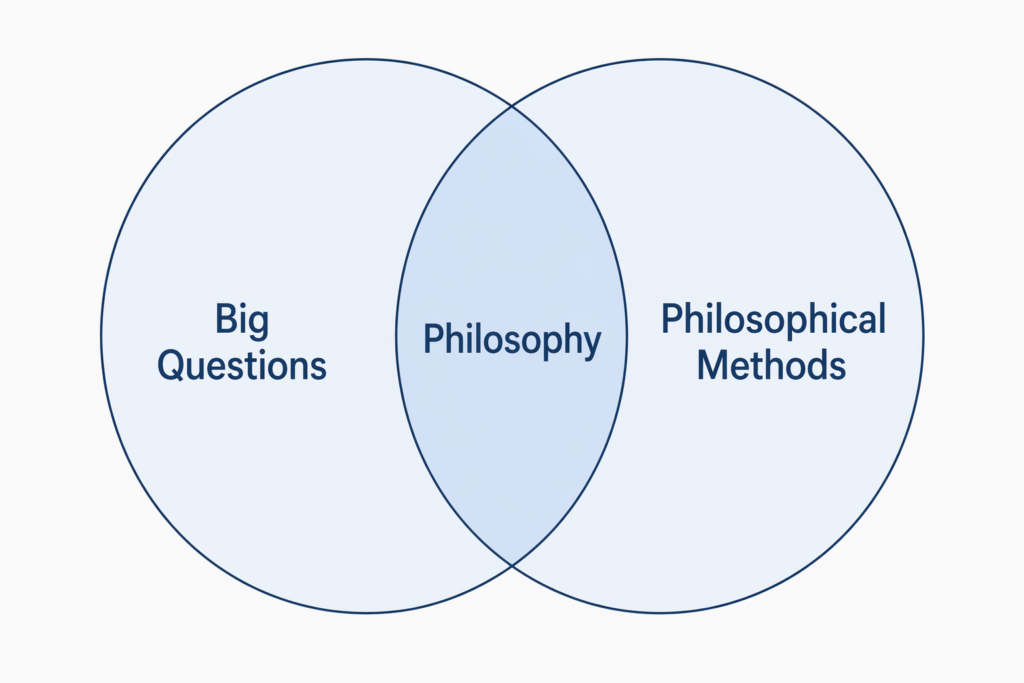
A useful way to look at philosophy is as a discipline that combines two things. On one side, its subject matter: big picture questions about mind, value, knowledge, and reality. On the other, its methods: conceptual analysis, careful definition, logical argument, thought experiments, and taking a meta-level perspective. Where both are present, you have philosophy proper. If only one is — big questions with scientific methods, or philosophical tools applied to small questions — it becomes only partly philosophical.
The clearest cases sit at the intersection of big questions and philosophical methods. These include the theory of knowledge, the study of what is, ethics, and the philosophy of mind. Here the questions are foundational and the tools are conceptual. This is philosophy’s home territory.
Move away from the intersection, and things get less philosophical. Cosmology asks big questions about the universe’s origin and structure, but answers them with mathematics and observation rather than conceptual analysis. In the other direction, much academic philosophy applies great rigour to narrow problems — impressive work, but not what most people imagine philosophy to be.
Philosophy was not always so narrow. For centuries, physics, biology, and psychology all lived under philosophy’s roof. Newton described his work as natural philosophy. The boundaries dissolved not because the questions changed but because new approaches arrived. Experimental, mathematical, and statistical work turned previously intractable problems into tractable ones. As each field developed its own methodology, it moved out. Philosophy kept the questions that remained. You could tell this story nobly: these are the hardest and deepest questions, and someone must keep asking them. Or less generously: philosophy has become the discipline of questions that resist every method, including its own.
The Big Picture
If philosophy combines big questions with philosophical methods, some philosophers will lean toward the questions, others toward the methods. I am very much a big-questions person — not because I dismiss philosophical methods, but because the big questions themselves feel primary. I want to ask what the universe is like, how life works, what humanity has learned about itself, how consciousness fits in, what we should value, and how we know. I want a comprehensive understanding across domains, using whatever methods work.
Most of what needs to be understood lies outside philosophy proper. And there is much to appreciate in what we have learned about the big picture. In outline, we now understand how the universe evolved from a dense beginning, how natural selection produced the variety of life, and how culture and cooperation made us the strange creatures we are. These are not small achievements and deserve to be savoured. Within this body of knowledge are important ideas such as entropy, relativity, quantum theory, genetics, and the power of large numbers that are as fascinating as anything in philosophy.
The most exciting advances in understanding are coming not from philosophy but from cross-disciplinary work. Evolutionary theory has reshaped how we think about human nature, and deep history has extended our sense of the human story. Cognitive science has begun to explain how minds actually work. An interdisciplinary approach matters here because the biggest questions do not fall neatly within a single field. Some of the books I have found most illuminating in recent years reflect that breadth — Richard Dawkins’ The Selfish Gene, Steven Pinker’s The Better Angels of Our Nature, Daniel Kahneman’s Thinking, Fast and Slow, Sean Carroll’s The Big Picture, and Daniel Dennett’s From Bacteria to Bach and Back. Together they show how much can be gained by bringing different kinds of insight to bear on the same large questions.¹
Big Picture Studies
I wish there were an academic discipline that explicitly dealt with our big picture understanding across all domains. Call it Natural Philosophy or Big Picture Studies. A Department of Big Picture Studies would cover physics and cosmology, life and evolution, human nature and society, consciousness, practical reason, and the theory of knowledge itself. It would map both what we know and what remains contested. It would consider the range of human worldviews and trace how they have shifted as knowledge accumulated. It would require conceptual skills, a well-developed sense of what matters, and a willingness to use all available methods. Big Picture Studies would aim for a balanced view of our understanding as a whole.
In the absence of an explicit Big Picture Studies discipline, philosophy remains the natural home for this kind of inquiry. That is not entirely satisfactory, because philosophy can be surprisingly narrow. Still, within philosophy you find people drawn to the same large-scale questions, and philosophy itself can be practised in a more big picture way. That means focusing on the most important questions, staying alert to significance, drawing freely on other disciplines, and using whatever methods help.
Philosophical skills are, in fact, central to work on the big questions. A strength of the books just mentioned is their use of philosophical expertise — clarity about concepts, logical thinking, and awareness of what matters. Philosophy can be helpful training for Big Picture Studies. But it is not, as currently practised, Big Picture Studies itself.
I have found it helpful to frame my interests in terms of understanding the big picture, rather than as learning about philosophy. The big picture project aims to bring together what we know and what we are still learning about the questions that matter most. It is exciting because we live at a moment when the sciences are reshaping our understanding and AI is expanding our capacity to learn and synthesise. Some central questions remain open — consciousness, the interpretation of quantum mechanics, why there is something rather than nothing. In this light, Big Picture Studies seems to me a better framework than philosophy for understanding, appreciating, and extending our picture of reality.
Note
- Richard Dawkins, The Selfish Gene (1976); Steven Pinker, The Better Angels of Our Nature: Why Violence Has Declined (2011); Daniel Kahneman, Thinking, Fast and Slow (2011); Sean Carroll, The Big Picture: On the Origins of Life, Meaning, and the Universe Itself (2016); Daniel Dennett, From Bacteria to Bach and Back: The Evolution of Minds (2017).