Is Morality Real?
Is Morality Real?
The question ‘Is morality real?’ is often framed as a forced choice. We are invited to choose between two stark options: either morality is objectively built into the fabric of the universe, as if right and wrong were quasi-religious features of reality, or morality is merely subjective, a matter of feeling, convention, or rhetoric. Both options are mistaken. This essay argues that morality is part of practical reason: it concerns judgements about how to act, and such judgements can be true or false depending on how they relate to welfare, harm, social cooperation, and other features of the world. In that sense, morality is real.
Morality Within Normativity
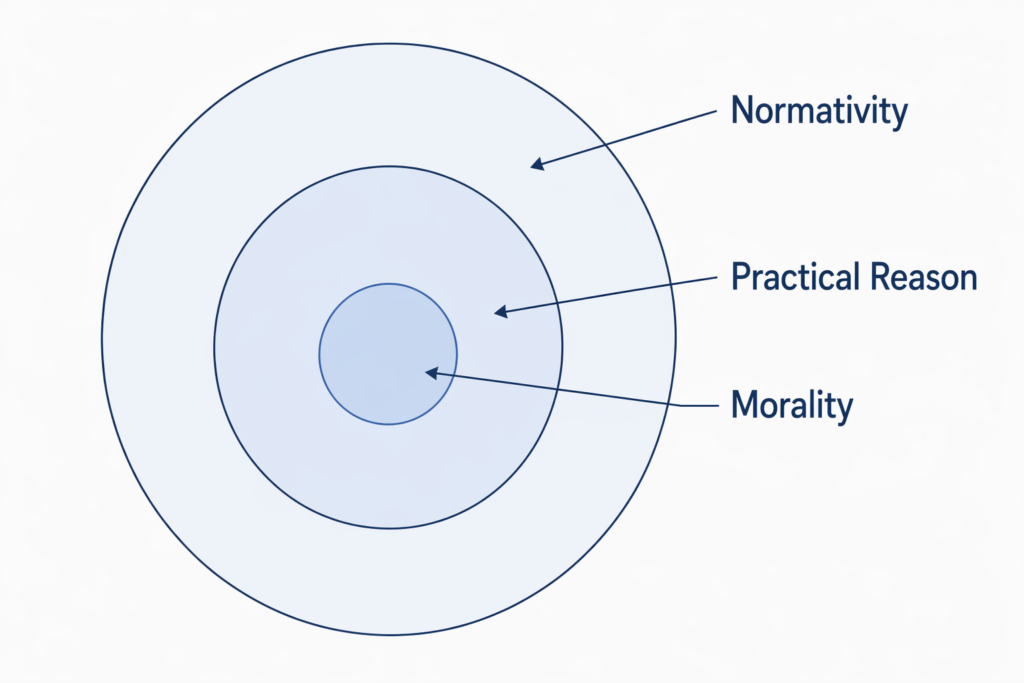
I begin by placing morality in a wider hierarchy. Normativity is the broadest category: the domain of value, oughts, and reasons. Within normativity, one major branch is practical reason, which broadly concerns choosing how to act. Morality is then a variably bounded part of practical reason, concerned especially with social rules, blameworthiness, and avoiding harm to others.
This shifts the debate. Instead of beginning with morality as though it were a separate realm, we begin with the more general phenomenon of normativity and practical reason. The question then becomes not ‘Are there strange moral properties?’ but ‘What is normative judgement, and in what sense can practical and moral judgements be true?’
End-Relational Normativity
A compelling answer is Stephen Finlay’s end-relational theory. Finlay analyses normative language such as ‘good’, ‘ought’, ‘should’, and ‘reason’, and argues that such language is fundamentally end-relational.¹ On his view, normative judgements do not point to a mysterious extra property of goodness or rightness. Rather, they concern relations between actions, facts, and ends.
This means that to say that something is good, or that one should do it, is to say that it stands in the right relation to some end. A sunny day is good for a wedding but bad if your crops need rain. It is right to eat a doughnut if you are starving, wrong if you are dieting. In each case, the judgement depends on how a thing bears on some aim or purpose.
What about apparently categorical judgements? Finlay’s answer is that the relevant end is often supplied by context rather than explicitly stated. A wedding guest may simply say that the sunshine is ‘good’, but the underlying end is still there. This suggests that even apparently categorical moral language may be less unlike ordinary normative language than it first appears.
Simple True Practical Judgements
Some practical judgements are plainly true. Suppose I am holding a nail against a wall with my thumb and am about to strike with a heavy hammer. The judgement that I should not hit my thumb seems plainly true. Its clarity comes from the structure of the case: the causal chain is short, the pain direct, the counterfactual simple, and there are no obvious longer-term advantages. This is not a deep moral puzzle but a basic practical truth.
What makes that judgement true is its relation to facts about the world. It is a human judgement that answers to facts and so can be true or false. In that sense, the judgement is real, though not in the stronger sense of being a truth built into reality independently of us. It is man-made in form, but world-involving in content.
Complexity and Uncertainty
Beyond simple cases, practical reason becomes harder. Consider the decision about which overseas development charity should receive £1,000. The question remains real, but the facts are harder to assess: effectiveness, counterfactual impact, higher-order effects, and even the relevant ends. One charity may focus on saving lives, another on reducing suffering. The best answer may be unclear, yet the choice is not arbitrary. One can still assess evidence, debate trade-offs, and rule out bad options. Giving the money to a fraudster is obviously worse.
This pattern is common: the best action may be uncertain, but foolish options are easier to spot. To drive from London to Edinburgh, the M1 or the A1 may each be defensible; the M2 would plainly be wrong. Practical reason often works less by finding a unique optimum than by ruling out plainly worse options. Disagreement therefore does not undermine its reality. Decent people can vote differently because outcomes are uncertain and institutions complex, while still trying to judge which choice is better.
Practical reason is often difficult because it involves predictions, counterfactuals, and alternatives. With so much uncertainty, sometimes we may feel we scarcely know what we are doing. But the sensible conclusion is not scepticism but modesty: practical judgement is real, but fallible, probabilistic, and often only partly determinate.
That should not surprise us. Practical reasoning is a core human skill: as creatures who must choose how to act, we have evolved capacities for navigating alternatives, however imperfectly. In a tradition that goes back to Aristotle, reasoning is divided between theoretical reasoning — about what is — and practical reasoning — about what to do. Our practical reasoning can draw not just on evolved capacities but also on accumulated experience and thought.
Ends
An end-relational account of normativity faces an obvious objection: if normative judgements are always relative to ends, what makes the ends themselves good or bad? Here too, we use reason. Ends need not be treated as brute givens or matters of taste; we can reason about which are better than others. In evaluating our goals we can check them for coherence and consistency and tease out implications. Reflection may not end in perfect agreement, but it can still distinguish between worthwhile and destructive aims. We may debate whether to aim for achievement or comfort, but we do not seriously debate whether pain is to be avoided.
Much reasoning about ends seems to converge on sentient welfare, and especially on valenced experience — conscious experience that feels good or bad. Even if positive valence is not the sole intrinsic value, it seems a major part of what is ultimately valued. It also provides a bridge between fact and value through our direct experience of pleasure and pain as good and bad.
Morality as Naturalistic Practical Reason
If broader practical reason is end-relational, does this extend to morality? Moral rules are often spoken of as having an absolute, categorical nature, so there is a challenge here. I think the answer has two parts.
First, much moral thinking already uses end-relational reasoning. Suppose someone finds a dropped wallet full of cash. There are usually many reasons to return it: concern for the owner’s welfare, fear of being caught, avoidance of guilt, support for social cooperation, and wanting to be a good person. These are naturalistic reasons. They are enough. We do not need to posit an extra quasi-religious reason standing behind the rule ‘don’t steal’. Moral rules can be understood as practical generalisations that capture recurrent patterns of reason.
Second, there is an evolutionary point. Why does morality often feel like more than practical reasoning? The answer is that we have evolved to experience certain moral rules as especially weighty and categorical because that helps social coordination and restraint. But that psychological force does not show that morality reflects a further layer of reality. It may instead reflect how creatures like us are disposed to think and feel.
This two-part picture helps explain why moral rules are usually strong without being exceptionless. If moral rules are practical generalisations grounded in recurring reasons, then unusual cases can alter the balance. If a starving person finds the wallet, the rules do not vanish, but they may be trumped by the needs of survival. If morality still feels categorical even here, that may simply show how powerfully such rules shape our thinking. The point is that morality remains a reason-sensitive part of practical judgement, not a set of sacred injunctions with a source outside human life.
Conclusion
The conclusion is that morality is real in the way that matters. Moral judgements are real in the sense that they can be true or false, and that their truth depends on how they relate to features of the world, including welfare, harm, social cooperation, and other rationally assessable ends. They are not real in the stronger sense of being irreducible moral properties or objective prescriptions built into the universe independently of human judgement.
Morality has often been treated as something that cannot properly be reasoned about, either because it is thought to come from God or because it is reduced to the expression of feeling. But if morality belongs within practical reason, and if normativity is end-relational in Finlay’s sense, then morality is itself a domain of reasoning about how to act. To reason morally is therefore not a philosophical mistake or a category error; it is central to what morality is.
¹ Stephen Finlay, Confusion of Tongues: A Theory of Normative Language (2016).