Objective World and Subjective Worlds
Objective World and Subjective Worlds
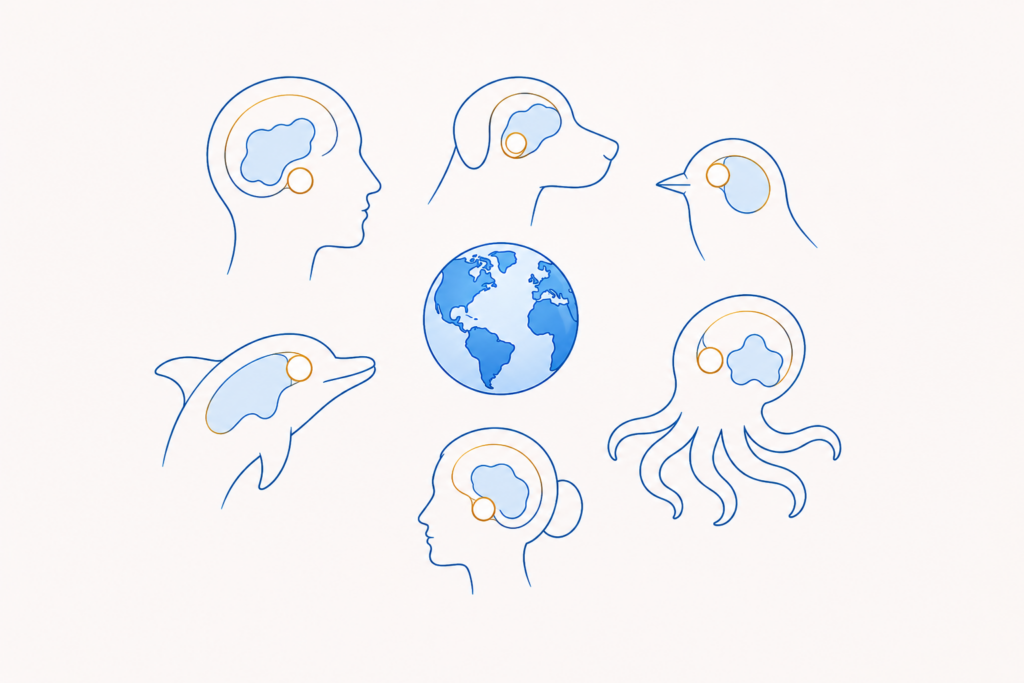
Each of us lives in two worlds: the objective external world and our own subjective world. Countless other subjective worlds exist alongside ours.
It is worth being clear how these worlds connect. In what follows I explore two themes: first, how consciousness emerged in the cosmos and how far it reaches; and second, how the objective and subjective meet in each of our lives.
How Consciousness Arose and its Extent
The physical universe is vast, ancient, and—so far as we know—purposeless. For most of its history it was only matter and energy. Only here, on earth, did evolution produce organisms with purposes. Some of them developed nervous systems, and out of those came minds.
In humans, and likely in many animals, consciousness includes positive and negative affect—joy and suffering, pleasure and pain. Once states can be better or worse than others, value enters the picture. Life on earth has brought value into a universe that would otherwise be only physical processes.
We know that humans are conscious, even if we do not fully understand how subjective experience arises. But beyond people we do not know how far consciousness extends. Do other mammals, birds, fish, or insects have inner lives? Research into animal consciousness has become a major field, yet our understanding remains limited. Today there are eight billion people, each with an inner life. Beyond us, there may be trillions of other consciousnesses, each radically different from our own. This is the biggest gap in our understanding: how many minds exist alongside us, and how strange their perspectives might be.
Non-human animal sentience is of overwhelming significance. If huge numbers of animals are capable of positive and negative affect, their experiences carry immense moral weight.
Yet our limited knowledge makes it hard to know how to respond. A precautionary principle has been proposed, for example in Jonathan Birch’s The Edge of Sentience¹, urging us to err on the side of caution when evidence of sentience is plausible. But the problem runs deeper. Even if sentience is established, we may still not know whether the lives in question are, overall, positive or negative. Suppose that a forest is destroyed. It is obviously bad in many ways, but one thing we may not know is whether the countless mammal, bird, reptile, and insect lives lost with it would, on balance, have been good or bad. If we do not know that, then we do not fully know whether the loss of the forest is, overall, a bad thing. Similar uncertainty arises more widely whenever non-human animals are affected, which often makes it hard to know what would be for the best.
The Duality of Subjective and Objective for the Individual
Now consider the individual. Each of us faces two worlds. There is the inner world of our own conscious experience, which evolved as a tool for controlling the body and is bound to the location and lifespan of that body. Alongside this is the vast ongoing objective world that includes the lives of others.
Thomas Nagel, in his essay Subjective and Objective², captures this tension. We inhabit our private world while also knowing that we are part of something much larger. We are subjects, bound to our own point of view, yet also able to step back and attempt a detached “view from nowhere.”
In Nagel’s view, both perspectives claim to be primary. From within, our subjective world feels like the centre of existence. From without, the objective picture swallows us into an impersonal whole. Neither can be dismissed. A clear-sighted outlook requires us to respect them both, refusing to let one obliterate the other. This duality is inescapable.
The clash between these two views can produce existential nausea—a feeling of vertigo when confronting our own mortality: seeing our cherished inner world as a fleeting accident in an indifferent cosmos. Writing a will feels surreal from the inside, yet perfectly sensible from the outside. One may also realise how little of the world and of time one will ever experience. From the inside, death is annihilation—the end of experience. For the universe it is next to nothing; for us it is everything.
The best approach to this duality is not to try to collapse one world into the other, but to acknowledge both. The task is to accept that we live in two worlds, each with its own claim on us.
Conclusion
Once we are clear about how the objective and subjective worlds interact, three main points emerge. First, consciousness arose out of purposeless matter and now exists on earth in many forms, bringing awareness and value with it. Second, each of us lives with two perspectives: the immediate, subjective view from within and the detached, objective view from without. Third, and most importantly, to be clear about how objective and subjective worlds relate is to see how strange our position is.
References
- Jonathan Birch, The Edge of Sentience (2024).
- Thomas Nagel, “Subjective and Objective,” in Mortal Questions (1979).